
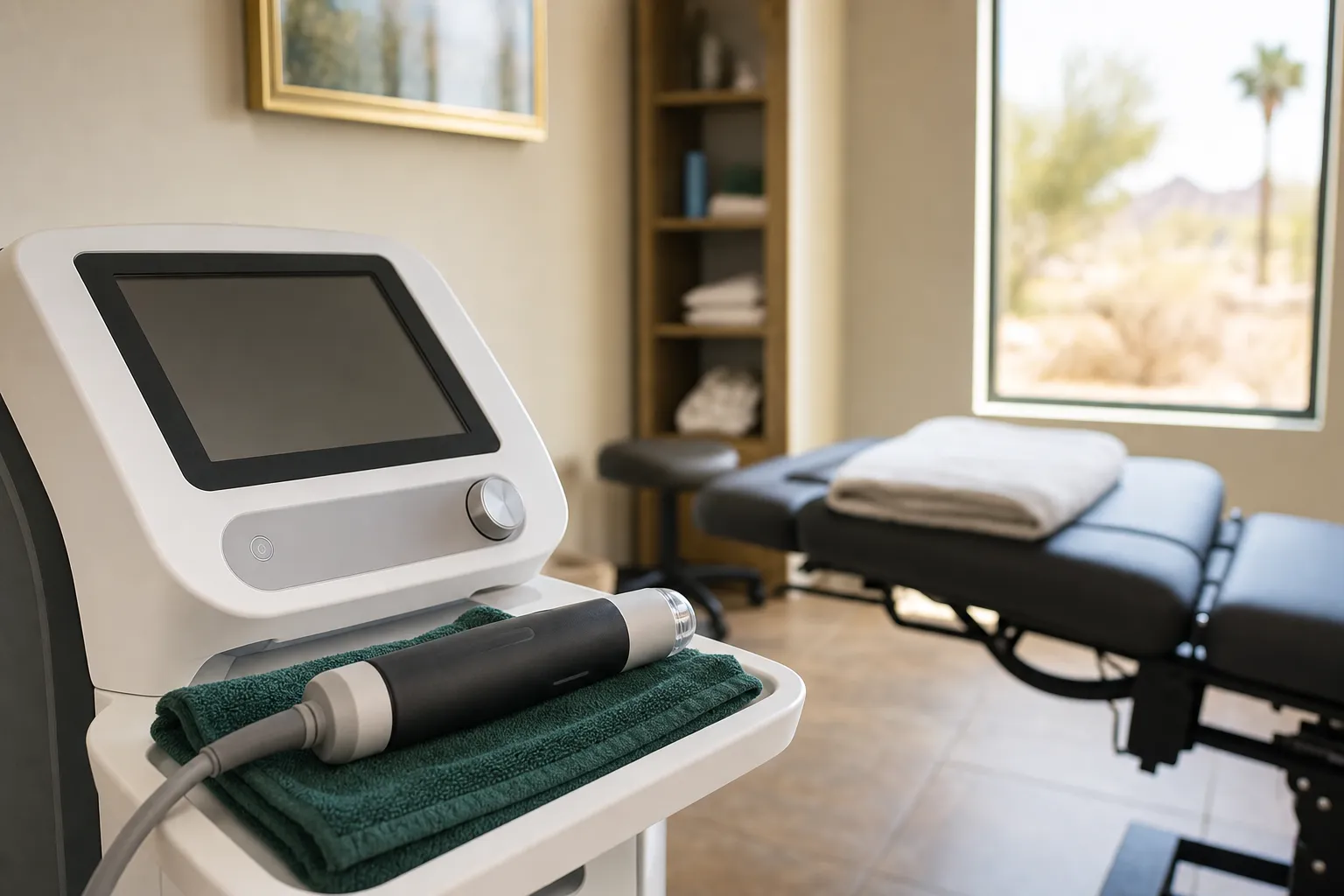
We recommend you ask whether Shockwave Therapy is appropriate for your condition, what outcomes to expect, how many sessions are likely, what side effects to watch for, and the clinician's training and licensing.
What is Shockwave Science and how it fits into chiropractic care
Shockwave Therapy is a noninvasive treatment that delivers focused acoustic pulses to soft tissue and tendon attachments to encourage healing and reduce chronic pain. As a chiropractic clinic that offers Shockwave Therapy, we use it alongside manual adjustments, massage, and other therapies to treat conditions that have not responded well to conservative care. For background on chiropractic as a profession, see the definition on Wikipedia.
Why these questions matter for people in the Recker Road Corridor and Queen Creek
Local factors affect care. We see patients from Queen Creek, Higley Groves and surrounding neighborhoods who work outdoors, perform repetitive tasks, or train for local events. Those activities change the risks and recovery expectations for tendon and soft tissue problems. Asking the right questions helps you decide whether Shockwave is likely to help you, and how it will fit with the rest of your treatment plan.
Key concepts to understand before you agree to treatment
- Indications. Shockwave is most commonly used for chronic tendon conditions such as plantar fasciitis, Achilles tendinopathy and some shoulder or elbow tendon problems.
- Mechanism and goal. The treatment aims to stimulate a biological healing response, reduce pain, and improve function. It is not the same as an adjustment or a surgical procedure.
- Course of care. Most plans use multiple sessions spread over several weeks, combined with exercise or manual therapy.
- Expected outcomes and variability. Some patients notice improvement within weeks, others need more time. Outcomes vary by condition duration, age, and activity level.
- Risks and side effects. Temporary soreness, bruising or local swelling can occur. Serious complications are uncommon when a licensed clinician follows accepted protocols.
- Provider qualifications. Who performs the therapy matters. Ask about licensing, training, and experience with the device being used.
Checklist of questions to ask your provider
Essential questions
- Is Shockwave Therapy recommended for my specific diagnosis and why.
- What is your experience treating this condition with Shockwave Therapy.
- Which device or manufacturer model will you use and is it appropriate for my diagnosis.
- How many sessions do you expect I will need and how often.
- What outcomes can I reasonably expect, and how will we measure progress.
- What are the common side effects and what should prompt me to call the clinic.
- How does Shockwave fit with adjustments, massage or targeted exercises we will do here.
- Are you licensed and insured to provide this treatment in Arizona.
Comparing Shockwave Therapy and other options
| What to compare | Shockwave Therapy | Other common options |
|---|---|---|
| Typical use | Chronic tendon and soft tissue pain that has not improved with rest and therapy | Manual adjustments, therapeutic exercise, massage, injections, or referral for advanced imaging |
| Invasiveness | Noninvasive, performed externally | Ranges from noninvasive therapies to minimally invasive injections |
| Course | Usually several outpatient sessions over weeks | Depends on therapy; exercises are ongoing, injections may be single or repeated |
| Risk profile | Low when performed correctly, with transient soreness possible | Varies, injections carry different risks; surgery has higher risks and longer recovery |
How we evaluate whether Shockwave is right for you
We begin with a focused history and physical exam to identify the pain source and contributing factors. If needed, we review prior imaging or recommend imaging only when it will change management. We consider duration of symptoms, response to prior care, and activity goals. Because Shockwave works best as part of a broader plan, we explain how it pairs with manual therapy, home exercises and activity modification.
Pro tip: Bring notes about what treatments you have already tried, including how long you did them and whether they helped. That helps us decide if Shockwave is a reasonable next step.
What good informed consent looks like
Good informed consent covers the expected benefits, the plan for measuring progress, the number and spacing of sessions, common side effects, and alternatives if Shockwave is not effective. We document this discussion and provide written takeaways so you can decide with confidence.
Common questions patients ask
Below are the most frequent concerns we hear and how we address them.
- Will it be painful? You may feel brief pulses during treatment and some soreness afterward. Discomfort is usually manageable and short lived.
- How soon will I see improvement? Some people notice changes after one or two sessions. Others need the full recommended course of therapy.
- Is Shockwave covered by insurance? Coverage varies by plan and diagnosis. We can provide documentation you can submit to your insurer.
- Can Shockwave replace adjustments or rehab exercises? No. We use it as one tool within a broader treatment plan that typically includes hands on care and specific exercises.
Related services we provide
Shockwave Therapy at our clinic is offered alongside other options to address neck and back complaints and soft tissue pain. Learn more about our Shockwave Therapy service, general Chiropractor care, and focused Back Pain Treatment and Neck Pain Treatment. We are licensed and insured to provide these services in Arizona.
Related locations we serve
We care for people across the Recker Road Corridor and surrounding communities. If you are local to Queen Creek, consider our Queen Creek location for in person evaluation and treatment planning.
Helpful resources and further reading
For background on the profession, the Wikipedia entry on chiropractic provides historical and conceptual context. If you want to review local regulation and licensing requirements, consult Arizona state resources about health professions. When you evaluate evidence, look for recent clinical reviews rather than single studies, and ask your provider which studies support the device they plan to use.
Questions that help you compare clinics
When you are comparing options locally, these practical questions help you judge quality without needing technical expertise.
- Who will perform the treatment. Ask whether a licensed chiropractor, therapist or technician will operate the device and who supervises the care.
- Device and protocol. Ask which device model will be used, and whether the clinic follows published treatment protocols for your condition.
- Integration with other care. Ask how Shockwave will be combined with manual therapy, exercises and activity changes to support long term outcomes.
Key takeaway
Key takeaway
Before starting Shockwave Therapy, ask whether it is appropriate for your diagnosis, who will perform it, the expected number of sessions, likely outcomes, and the plan for combining it with other treatments. That conversation helps you set realistic expectations and choose care that fits your goals and local lifestyle in Queen Creek.
Frequently asked questions
Is Shockwave Therapy safe?
When performed by a trained, licensed clinician using accepted protocols, Shockwave Therapy has a low rate of serious complications. Temporary soreness, mild bruising or swelling are common. We discuss risks before starting treatment.
How many sessions will I need?
Typical courses are three to six sessions spaced weekly or every other week. The exact number depends on your condition, its duration, and how you respond. We set expectations together after the initial evaluation.
Can anyone receive Shockwave Therapy?
Not everyone is a candidate. Pregnant patients, people with certain blood disorders, or those with active infections at the treatment site are usually excluded. We review contraindications during screening.
Will insurance cover Shockwave Therapy?
Insurance coverage varies by plan and diagnosis. We can provide visit documentation that you may submit to your insurer. Coverage decisions are made by each payer.
Learn more and check our local presence
Read patient feedback and find directions on The $35 Chiropractor Google Business Profile, and explore related topics and services on our site to prepare for your visit.