
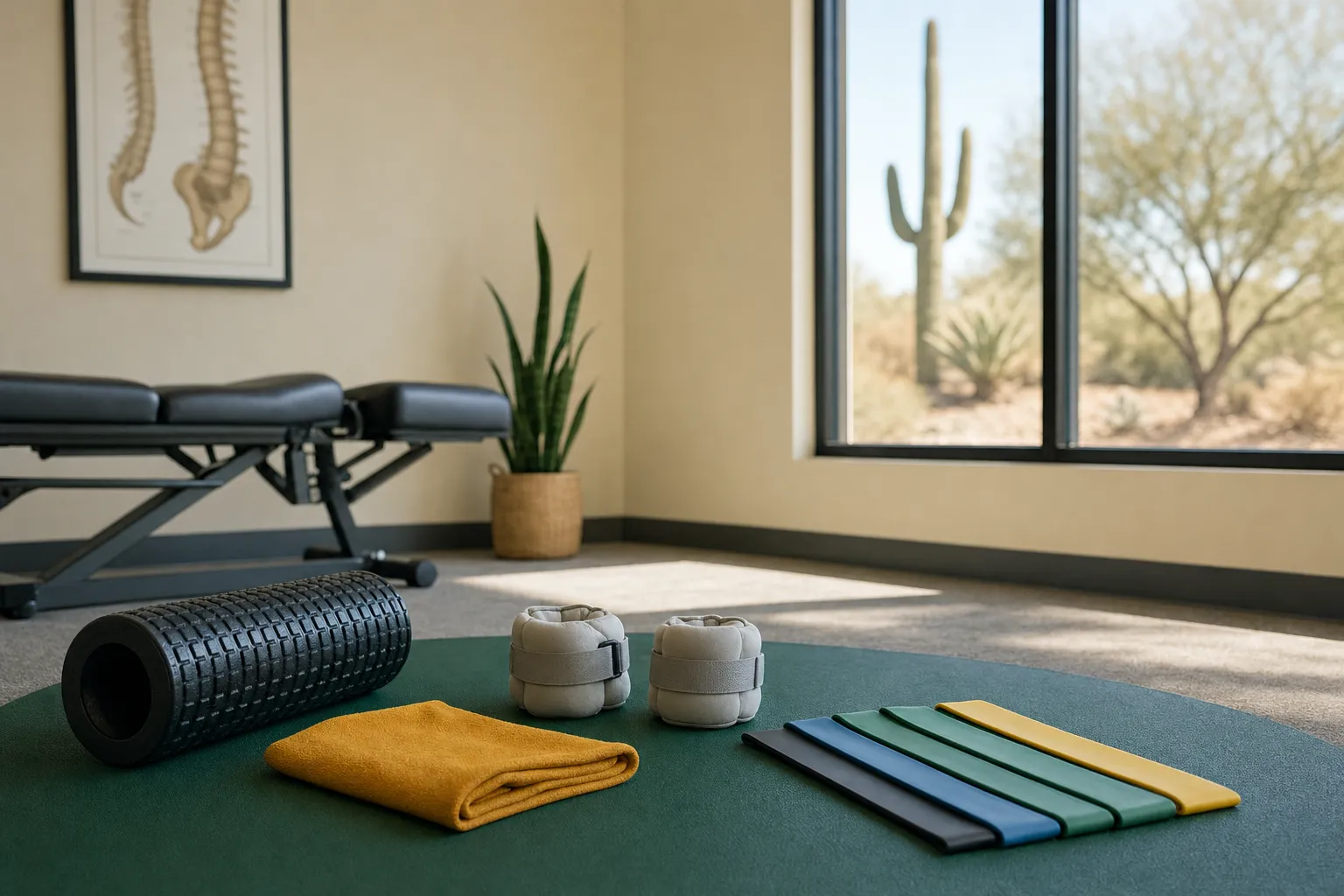
Rehabilitation exercises help restore movement, reduce pain, and lower the chance of the problem coming back, but only when they are tailored to you, progressed safely, and monitored by a licensed clinician. We use targeted exercise plans alongside hands on care to move patients from pain to function in Eastmark and nearby Queen Creek.
What rehabilitation exercises are
Definition and purpose
Rehabilitation exercises are specific movements and progressive activities chosen to restore strength, flexibility, coordination and function after an injury, flare up, or surgery. Unlike general fitness routines, these exercises target the tissues and movement patterns that are relevant to your symptoms and daily activities.
Common categories
- Range of motion and joint mobility exercises to restore comfortable movement.
- Strengthening for weak muscles that are contributing to pain or instability.
- Neuromuscular reeducation to rebuild movement patterns and coordination.
- Balance and proprioception work to reduce fall and reinjury risk.
- Functional training that mirrors tasks you do at home, work, or on the field.
Why rehabilitation exercises matter in Eastmark and Queen Creek
Local life affects recovery choices. Eastmark residents often return to outdoor walking, neighborhood sports, and physically active hobbies, while many Queen Creek jobs involve standing, lifting, or repetitive movement. Rehabilitation that only reduces pain but does not restore the specific strength and movement you need leaves you at higher risk of recurrence.
We design programs with local demands in mind so you can return to the exact activities you care about, whether that is walking the Villages at Eastmark, gardening, or playing youth sports nearby.
Key concepts to understand before you decide
What makes an effective rehab exercise program
- Assessment driven. Exercises should follow a movement and strength assessment that shows what is limited or weak.
- Individualized. Two people with low back pain rarely need the exact same program.
- Progressive load. Difficulty should increase in a planned way so tissues adapt.
- Functional. Exercises should transfer to daily life, not just look good in the clinic.
- Monitored. Regular review catches symptoms that need modification.
Checklist: What to expect from a quality program
- Initial assessment with movement and pain screening.
- Clear short term goals and measurable milestones.
- Mix of clinic sessions and a manageable home program.
- Progression plan with timeline estimates.
- Coordination with hands on care, massage, or other therapies when helpful.
How we approach rehabilitation exercises
We start with a focused evaluation that looks at posture, joint range, strength, and how your pain changes with movement. From that assessment we build a program that links exercises to the goals you care about, for example returning to gardening or reducing the frequency of migraines that are aggravated by neck tension.
We combine exercise with manual therapy and, when indicated, services like Massage or Shockwave Therapy to reduce pain so you can perform the exercises effectively. Our clinical notes document progress so we can adjust load and complexity as you improve.
Common questions people ask
Will exercises make my pain worse
Not when they are chosen and progressed correctly. Some soreness is normal when you start strengthening, but sharp or increasing pain is a signal we change the approach. We teach you how to tell the difference between productive soreness and harmful pain so you can proceed safely.
Pro tip: Keep a simple pain and activity diary for one week. It helps your clinician link specific movements to symptoms and speeds up the right exercise choice.
How often should I do the exercises
Frequency depends on the goal and the tissues involved. A typical plan includes clinic visits for hands on guidance plus a short, daily home routine that focuses on quality not quantity. We set a schedule you can realistically follow while keeping progression consistent.
Watch out: Avoid following generic video routines that were not prescribed for your condition. They can reinforce poor movement patterns or overload vulnerable tissues.
How long until I notice change
Many patients notice reduced pain or improved ease of movement within two to six weeks, while meaningful strength and return to demanding activities can take two to three months or longer. Timelines vary with the severity of the condition and how well the program is followed.
Comparison: Home guided exercises versus supervised clinic programs
| What differs | Home guided exercises | Supervised clinic program |
|---|---|---|
| Assessment quality | Often limited to self report or a single video call | Hands on assessment, objective movement testing |
| Progression | May stall or progress too fast | Planned progression based on observed response |
| Transfer to daily tasks | Depends on patient interpretation | Clinician links exercises to real tasks |
What we will not do in this guide
We will explain the purpose of rehabilitation exercises, the markers of program quality, and how clinicians make choices. We will not provide a complete do it yourself protocol that replaces a licensed clinician, because individual assessment and progression matter for both safety and results.
Related services and where they fit
Rehabilitation exercises are often part of a broader plan. Related services we coordinate with include the core Chiropractor service for spinal and joint care, targeted Back Pain Treatment when the back is the primary issue, and Massage to reduce soft tissue tension that limits movement.
When needed, we also integrate Shockwave Therapy or Acupuncture to help pain settle so exercises can be effective.
Where we provide this care locally
We care for patients across Queen Creek and surrounding neighborhoods, including Eastmark. If you live in or near Eastmark and want an assessment that considers local activities and lifestyle, we can evaluate how your daily tasks should guide your rehab priorities. Learn more about our Queen Creek location for practical details.
Helpful external resources and evidence
For national standards and professional guidance, the American Chiropractic Association outlines practice principles and the role of rehabilitation in chiropractic care. For an independent review of spinal rehabilitation options, Harvard Health Publishing describes how movement and manual care are used for low back pain. For workforce and occupational data about chiropractors, the Bureau of Labor Statistics provides occupational outlook and employment context in healthcare.
How to choose the right program for you
- Get a movement based assessment. Choose a clinician who watches you move in activities that matter.
- Ask for measurable goals. Good plans define what success looks like and how progress is measured.
- Expect a blend of clinic time and home work. Clinic time is for instruction and progression, home work is for consistent practice.
- Look for coordination with other therapies. If soft tissue tension or chronic pain limits exercise, integrated care speeds recovery.
Key takeaway
Rehabilitation exercises are most effective when they are individualized, assessed by a licensed clinician, and progressed to match the activities you need to return to. Supervised programs reduce risk, improve outcomes, and connect exercise choices to real life. We design and monitor those programs for patients in Eastmark and Queen Creek.
Frequently asked questions
Can I start rehabilitation exercises without seeing a chiropractor
Light mobility work can be started, but a full rehabilitation program should follow an assessment. We recommend at least one professional evaluation to identify the right targets and to avoid reinforcing poor movement patterns.
What makes a home exercise program effective
An effective home program is short, specific, measurable, and written down. It includes clear cues for how to do each exercise, a frequency that fits your schedule, and planned progression steps that your clinician reviews.
Will rehab exercises fix chronic back pain
Many people with chronic back pain get meaningful improvement with targeted rehabilitation and coordinated care, but outcomes vary. Rehabilitation aims to reduce pain, improve function, and lower recurrence. When underlying medical issues exist, we coordinate care with other providers.
How do you measure progress
Progress is measured with pain scales, strength or range tests, functional tasks such as lifting or walking, and patient reported measures of confidence and activity. We document these so you can see objective change.
Learn more and read reviews
Read patient experiences and get directions on our Google Business Profile, and explore related topics and services on our site to learn how rehabilitation exercises fit into a complete care plan.